

Can frequent work travel affect child custody in North Carolina?
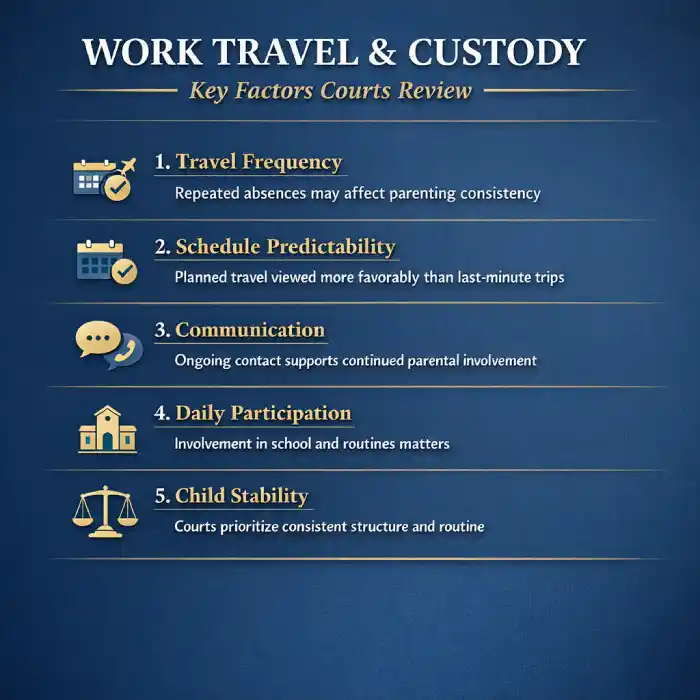
Yes, when the travel affects the child’s care, safety, or practical parenting schedule. Business travel does not automatically disqualify a parent from custody. The court applies the child’s best interests, and changing an existing permanent custody order requires more than showing that one parent travels. Focus on the child’s actual needs and a workable plan.
A useful travel plan answers who will care for the child, how exchanges will happen, and what happens when a flight or assignment changes. General promises to “be flexible” leave important details unresolved.
What legal standard applies to a traveling parent?
G.S. 50-13.2 directs courts to consider the child’s best interests and relevant factors, including domestic violence and safety. There is no preference between parents under that provision. Neither the parent with the more flexible job nor the parent with the higher income automatically receives custody.
The practical question is how a proposed arrangement works for this child. A regular overnight business trip and an unpredictable multiweek assignment may require different planning. Neither description alone establishes the outcome.
What should a work-travel parenting plan address?
Consider these drafting topics with counsel. They are planning options, not mandatory terms for every family:
- Advance notice: when known travel dates will be shared and what happens when an employer changes them.
- Actual availability: realistic pickup times, including the trip home from the airport.
- Backup care: who can help, their availability, and any restrictions in the existing order.
- School and activities: transportation, homework, medication, and established routines.
- Schedule exchanges: how requests are made, how acceptance is recorded, and when make-up time is appropriate.
- Unexpected delays: how the child remains supervised if a return trip is interrupted.
- Communication: an age-appropriate contact window that accounts for time zones and bedtime.
For example, a parent who returns late on Thursday might propose a Friday pickup instead of repeatedly missing Thursday exchanges. That is a proposal to assess against the child’s needs and the order, not a right to change the schedule unilaterally.
Does a new travel schedule justify modifying custody?
G.S. 50-13.7 addresses modification based on changed circumstances, subject to jurisdictional requirements. For an existing permanent order between parents, the analysis generally requires a substantial change affecting the child’s welfare and then whether modification serves the child’s best interests. North Carolina appellate decisions explain this standard; see the Court of Appeals’ published custody decisions.
A new job or more travel is not enough to predict the result without examining its effect on the child. Document changes such as missed exchanges, unavailable supervision, disrupted schooling, or a newly workable schedule. Counsel should first determine whether the existing arrangement is a permanent order, a temporary order, or an agreement, because the procedural posture matters.
See our guide to modifying a North Carolina custody order for the broader process.
Can parents agree to swap time around work trips?
Read the current order first. Some orders provide a method for agreed changes; others contain specific requirements that need legal review. A text exchange does not by itself rewrite a court order. For a lasting change, ask counsel whether an amended consent order or other court action is needed.
The court’s custody mediation program can help parties negotiate a parenting agreement in a filed custody case. Mediation is generally required unless waived by a judge. A mediator helps the discussion but does not decide custody. An agreement becomes a court order when a judge signs it. Have counsel review proposed language before signing, particularly where safety or protective orders are involved.
Can video calls replace missed parenting time?
No. Under G.S. 50-13.2(e), electronic communication may supplement in-person custody or visitation but cannot replace it. Electronic contact time also cannot be used to calculate child support or justify relocation. A call schedule should support the child’s relationship with the traveling parent without disrupting sleep, school, or existing restrictions.
What records help explain the effect of travel?
- A calendar comparing scheduled parenting time with time actually exercised.
- Travel dates and employer scheduling information relevant to availability.
- Written requests and responses about exchanges or backup care.
- School, medical, or childcare records showing a specific effect on the child.
- A realistic proposed schedule, including transportation and contingency plans.
Keep records factual and complete. A calendar should show successful arrangements as well as problems. Avoid coaching the child, collecting information unlawfully, or turning routine communication into accusations. The aim is to explain the child’s circumstances accurately.
Frequently asked questions about work travel and custody
Will hiring a babysitter automatically count against me?
No automatic conclusion follows from using childcare. Review the child’s needs, the caregiver’s suitability, and the current order. If the order contains an offer-of-care or other caregiver provision, follow its actual terms.
What if both parents travel?
Prepare a combined calendar and identify gaps in care before proposing a schedule. Address backup caregivers, exchange responsibilities, and delays instead of assuming one parent’s employer will always accommodate the other.
Does military deployment follow the same rules?
Military service can involve additional protections. G.S. 50-13.2(f) prohibits using past or possible future deployment as the sole basis for the best-interests decision, while allowing consideration of its significant impact. Obtain advice specific to deployment rather than treating it as ordinary business travel.
If you are facing this situation, call Martine Law before you sign or file anything. $50 consultation with our Director of Client Engagement. Full refund if you’re not satisfied, for any reason. We have offices in Charlotte, Raleigh, Cary, and Belmont. Call (919) 925-4613 or (704) 842-3411, or send us a message. Phones and chat are answered 24/7, with AI covering when no staff is free.