

Quick answer: A qualifying military deployment can require a temporary North Carolina parenting plan, but does not automatically take away custody. The Uniform Deployed Parents Custody and Visitation Act provides rules for notice, temporary caregiving, hearings, communication, and ending deployment arrangements. The existing order, the service orders, and the child’s needs determine which steps fit your situation.
Does deployment mean losing custody in North Carolina?
No automatic loss follows from deployment. Under G.S. 50-13.2(f), past deployment or possible future deployment cannot be the only basis for deciding the child’s best interests. A court can consider a significant impact on those interests. Military service therefore provides important protections, but does not erase safety concerns or decide every custody dispute.
First check whether the assignment falls within the Act. G.S. 50A-351 defines deployment as qualifying official movement or mobilization for more than 90 days but less than 18 months, with orders that are unaccompanied, do not authorize dependent travel, or otherwise prevent family members from moving there. A permanent change of station or short training assignment should not simply be assumed to meet that definition.
When must a deploying parent notify the other parent?
G.S. 50A-354 generally requires notice in a record within seven days after receiving deployment notice. If service circumstances reasonably prevent timely notice, give it as soon as reasonably possible. Each parent must also provide a plan for their share of custodial responsibility as soon as reasonably possible.
There are exceptions: when an order protects the other parent’s address or contact information, notice goes only to the issuing court. Parents living together with actual notice do not need the separate recorded notice. Keep copies of notices and delivery records; do not violate a protective order to communicate directly.
What belongs in a temporary military parenting agreement?
A qualifying agreement must be written and signed as required by G.S. 50A-360. Useful terms include:
- Who provides daily care and who makes school and medical decisions.
- Deployment dates and conditions to the extent feasible.
- Video or telephone contact, scheduling, assistance, and communication costs.
- Parenting time during leave and a process for resolving disputes.
- How the arrangement ends after deployment and who handles required filing.
The agreement cannot itself modify an existing child-support obligation. Ask the appropriate court about a support modification instead of informally stopping payments. Compare the proposed schedule with your existing order and the child’s school, transportation, and health needs. Our parenting-time schedule guide offers additional planning questions.
What if the parents cannot agree before deployment?
Either parent can seek a temporary custody order after deployment notice. G.S. 50A-370 directs the request into an existing proceeding with jurisdiction or a new action when appropriate. It also prohibits a permanent custody order in the deploying parent’s absence without that parent’s consent, and makes temporary relief subject to the Servicemembers Civil Relief Act.
The court must conduct an expedited hearing when the motion is filed before deployment. A party or witness who is not reasonably available in person may generally provide testimony and evidence electronically, unless the court finds good cause to require personal appearance. These rules appear in G.S. 50A-371 and 50A-372. They do not establish a universal number of days for completion. Bring service orders and promptly tell counsel about availability and communication restrictions.
Can a grandparent or stepparent provide care during deployment?
Possibly. Under G.S. 50A-374, the deploying parent may ask the court to grant care to an adult family member or an adult with a close and substantial relationship with the child, consistent with state law and the child’s best interests. Without the other parent’s agreement, time generally cannot exceed the deploying parent’s ordered time, or habitual care time if there is no permanent order, with an allowance for unusual travel time.
A relative does not automatically inherit the service member’s schedule. The court must specify any decision-making powers granted, and the nonparent becomes a party while the grant remains in effect.
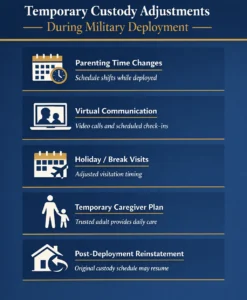
Does temporary custody end the day a parent returns?
Not necessarily. For a temporary agreement, G.S. 50A-385 allows the parents to sign a termination agreement. Without one, the arrangement generally ends 60 days after the deploying parent gives the other parent notice of return, subject to the statute’s earlier-termination provisions. If the original agreement was filed, the termination agreement must also be filed.
For a temporary court order, G.S. 50A-388 generally provides a 60-day period after return notice to the other parent and any nonparent granted custody when applicable, if no termination agreement has been filed. Proceedings to terminate or prevent termination remain possible under state law. Confirm the notice recipients, dates, and controlling orders before changing exchanges.
Frequently asked questions about deployment and NC custody
Can we agree to end a temporary court order sooner?
After return, parents may file an agreement to terminate the temporary order. The court then issues a terminating order for the agreed date, or immediately if no date is specified. See G.S. 50A-386.
Can the returning parent see the child during the transition?
Yes. G.S. 50A-387 requires temporary reasonable contact pending termination unless contrary to the child’s best interests. The permitted contact can exceed the parent’s predeployment time.
What should I bring to a custody consultation?
Bring the current custody and support orders, service orders, deployment and return notices, proposed caregiver information, school calendar, and a practical communication plan. Flag any protective orders, safety concerns, and upcoming court dates. For broader help, see our North Carolina child custody services.
If you are facing this situation, call Martine Law before you sign or file anything. $50 consultation with our Director of Client Engagement. Full refund if you’re not satisfied, for any reason. We have offices in Charlotte, Raleigh, Cary, and Belmont. Call (919) 925-4613 or (704) 842-3411, or send us a message. Phones and chat are answered 24/7, with AI covering when no staff is free.