

If you are a military parent, deployment can affect your parenting schedule and responsibilities. In military deployment custody North Carolina cases, courts review existing parenting plans to determine whether temporary changes are required during deployment. Judges focus on maintaining stability for the child while protecting the deployed parent’s rights and allowing the custody arrangement to return to its original form after service obligations end.
If you are a military parent, deployment can disrupt your parenting schedule due to travel, training, or overseas assignments. In military deployment custody North Carolina cases, courts recognize that service obligations may prevent you from following an existing custody order. Instead of making permanent changes, courts review whether temporary adjustments are needed to maintain stability for the child during deployment.
North Carolina courts focus on protecting the child’s routine while preserving your legal rights. Judges may review parenting responsibilities, living arrangements, and communication plans to ensure consistent care while deployment is ongoing.
Martine Law explains how military service obligations affect custody arrangements and how parenting plans are adjusted during deployment under North Carolina law.
What Happens to Child Custody When a Parent Is Deployed in North Carolina?
When a parent is deployed, North Carolina courts may review the existing custody arrangement to determine whether temporary changes are necessary. Deployment does not automatically change custody rights, but it may affect how parenting time is carried out during the service period.
If you want to review how courts structure custody responsibilities, you may explore how custody orders in North Carolina are typically handled under state family law.
Courts often examine practical factors before approving adjustments:
- The expected duration and location of deployment
- The child’s schooling and living environment
- Communication opportunities between parent and child
- Whether the existing parenting schedule can continue realistically
These factors help courts determine whether temporary changes are necessary while maintaining the child’s stability.
How Do Courts Evaluate Military Deployment Custody North Carolina Cases?
Courts review military deployment custody North Carolina situations by balancing the child’s best interests with the realities of military service. Judges first examine the current custody order to determine whether the schedule can still function during deployment.
If the schedule becomes impractical, the court may review a modification timeline custody NC request. This timeline depends on the expected deployment length and whether temporary adjustments are needed to maintain a stable living environment for the child.
In some cases, courts may also evaluate parenting schedules and communication arrangements. You can review how courts structure parenting responsibilities through parenting time schedules in North Carolina when evaluating custody plans.
Judges generally aim to maintain continuity for the child while ensuring the deployed parent retains meaningful parental rights.
When Can a Parenting Plan Be Temporarily Modified During Deployment?
Temporary custody changes may occur when military obligations prevent a parent from following the original parenting schedule. Courts may approve adjustments so the child continues to receive stable care while the deployed parent completes service duties.
A modification timeline custody NC issue often arises when deployment dates conflict with an established custody order. Instead of permanently altering custody, courts usually approve temporary arrangements lasting only during the deployment period.
Temporary arrangements may include:
- Adjusting parenting time while the service member is deployed
- Allowing video calls or scheduled communication
- Modifying school break or holiday visitation
- Establishing temporary caregiving arrangements if needed
These adjustments help ensure the child maintains stability while preserving the deployed parent’s involvement whenever possible.
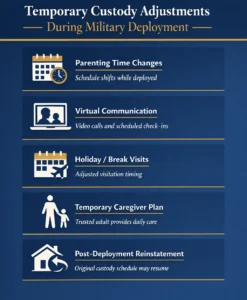
Source: Servicemembers Civil Relief Act.
How Does North Carolina Protect Service Members in Custody Cases?
North Carolina law recognizes that military service obligations can temporarily affect parenting schedules. Courts generally avoid making permanent custody changes simply because a parent is deployed.
Instead, judges evaluate whether the deployment is temporary and whether the parenting arrangement can resume once the service member returns. This approach prevents military service from unfairly affecting long-term custody rights.
Courts also emphasize maintaining the relationship between the child and both parents. Judges often encourage communication between the deployed parent and the child whenever possible so the family relationship remains intact throughout the service period.
What Happens After a Deployed Parent Returns Home?
When deployment ends, courts may review whether the original parenting schedule should resume. In many cases, temporary custody arrangements automatically expire once the deployed parent returns.
However, a modification timeline custody NC review may occur if the temporary arrangement significantly changed the child’s living situation. Judges evaluate whether returning to the previous schedule supports the child’s stability and overall well-being.
Courts may also examine how the child adjusted during deployment and how the returning parent can transition back into their regular parenting role.
For additional context on how courts sometimes replace earlier custody arrangements, see:
Know More – Modifying Child Custody in NC: substantial change in circumstances
How Military Deployment Can Influence Parenting Plans in North Carolina
Military deployment can temporarily change how parenting responsibilities are structured in North Carolina custody cases. Courts review parenting plans to determine whether adjustments are necessary while a service member fulfills military duties.
Temporary custody modifications may address communication schedules, caregiving arrangements, and parenting time adjustments. Once deployment ends, courts often review whether the original parenting plan should resume.
Understanding how military deployment custody North Carolina matters are evaluated can help parents anticipate how custody arrangements may shift during service periods.
If you would like more information about how custody laws apply when military obligations affect parenting plans,
Martine Law can provide general guidance. You may call (704) 842-3411 or visit the Contact Us page to learn more.
Frequently Asked Questions
Can military deployment permanently change custody in North Carolina?
No. Military deployment alone does not automatically create permanent custody changes in North Carolina. Courts generally view deployment as a temporary circumstance rather than a reason to permanently reduce parental rights. Judges may approve short-term adjustments to parenting schedules while the service member is away, with the expectation that the prior arrangement can be reviewed once deployment ends.
Can a deployed parent maintain communication with their child during deployment?
Yes. Courts often support consistent and meaningful communication between a deployed parent and child whenever circumstances allow. Parenting plans may include scheduled phone calls, video calls, emails, or written communication depending on military duties and location. These arrangements help preserve the parent-child relationship, provide stability, and encourage continued involvement during the deployment period.
How do courts evaluate military deployment custody in North Carolina situations?
In military deployment custody North Carolina cases, courts examine whether deployment prevents compliance with the current parenting schedule. Judges may review the child’s stability, available communication with the deployed parent, and whether temporary changes are necessary. The focus is usually on protecting the child’s routine while preserving each parent’s legal rights and future parenting role.
Can parenting plans be temporarily modified during military deployment?
Yes. Courts may approve temporary parenting plan changes when military service makes the current schedule impractical. These adjustments can include modified visitation dates, remote communication schedules, or temporary caregiving arrangements. Judges usually structure these changes to remain in effect only during deployment, allowing the prior plan to be reconsidered once service obligations end.
How can parents prepare for possible custody changes before deployment?
Parents can prepare by reviewing the current custody order and identifying how deployment may affect schedules, exchanges, and communication. Some families create temporary agreements in advance to reduce conflict and clarify responsibilities. Keeping records, sharing deployment details when appropriate, and addressing concerns early can help support smoother custody adjustments during the service period.