
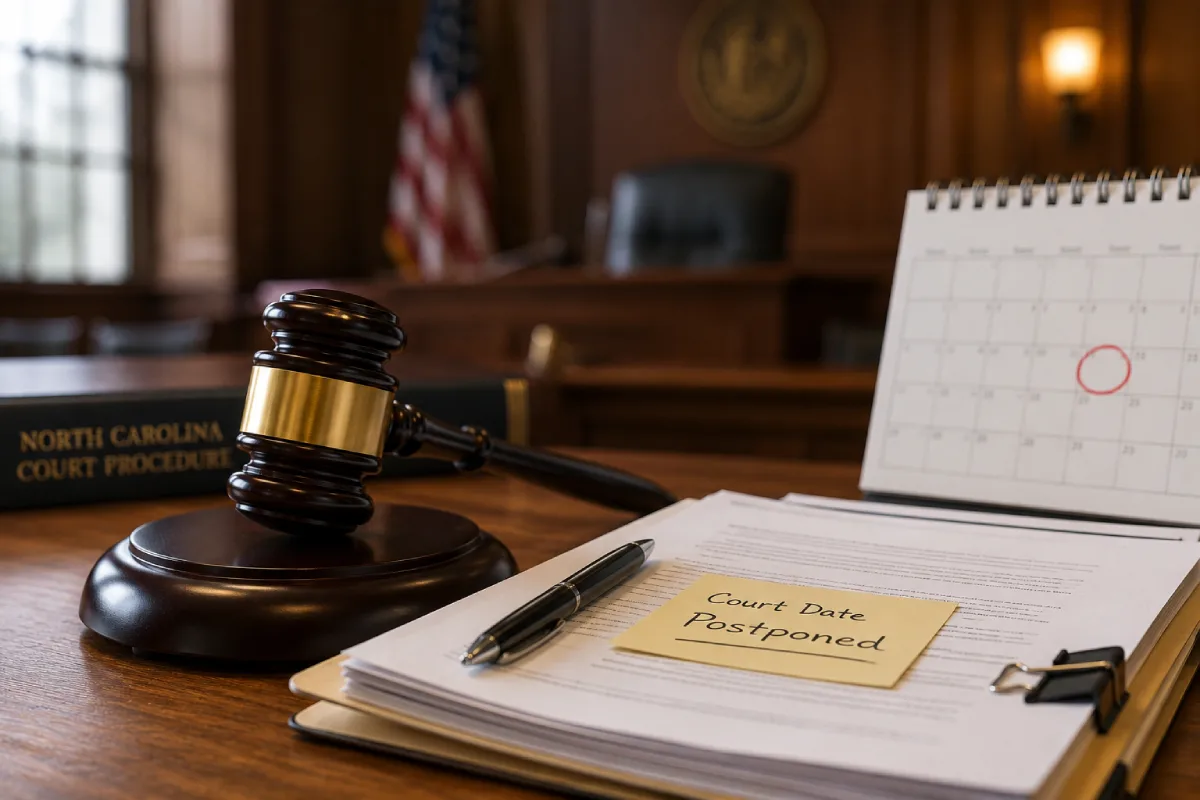
A scheduled court date does not always proceed as originally planned. Witnesses may become unavailable, attorneys may need additional time to prepare, newly disclosed evidence may require investigation, or unforeseen emergencies may arise. In these situations, a party may ask the court to postpone the proceeding through a motion for continuance.
This Martine Law guide explains what a continuance means in the courts, how a motion for continuance is evaluated, common reasons judges grant or deny requests, whether there is a limit, and what happens after a court date is postponed.
What Is a Continuance?
A continuance is a judicial order postponing a scheduled court proceeding to a later date. It does not resolve the underlying case or affect the merits of the charges or claims. Instead, it removes the matter from its current calendar setting and assigns a future hearing, trial, or other proceeding. Continuances may occur in criminal prosecutions, civil litigation, family law matters, juvenile proceedings, traffic cases, and administrative hearings where authorized. Depending on the procedural posture of the case, a continuance may postpone:
- First appearance
- Probable cause hearing
- Calendar call
- Motion hearing
- Bench trial
- Jury trial
- Sentencing hearing
- Other scheduled proceedings
The legal authority in criminal proceedings includes N.C. Gen. Stat. § 15A-952(g), which recognizes motions for continuance as pretrial motions, together with the court’s inherent authority to manage its docket and the North Carolina General Rules of Practice governing requests. Local judicial district rules may establish additional procedural requirements.
What Is a Motion for Continuance?
A motion is the procedural mechanism used to request that the court postpone a scheduled proceeding. Depending on the circumstances, the motion may be:
- Filed in writing before the scheduled court date
- Made orally during court when circumstances unexpectedly arise
- Submitted by either party
- Requested jointly by both parties
Although procedural requirements vary among judicial districts, a motion generally identifies:
- The proceeding to be continued
- The current court date
- The reason additional time is needed
- Facts establishing good cause
- Whether opposing counsel objects
- The requested length of the continuance
The court may require supporting documentation, affidavits, medical records, or other evidence demonstrating why the postponement is necessary.
Who May Request a Continuance?
A continuance may be requested by several participants in the case.
The Defense
Defense counsel may request additional time to:
- Review discovery materials
- Investigate factual issues
- Interview witnesses
- Retain expert witnesses
- Prepare constitutional or evidentiary motions
- Evaluate plea negotiations
- Obtain records necessary for trial
The Prosecution
The State may seek a continuance when necessary to:
- Secure the attendance of essential witnesses
- Complete forensic testing
- Obtain additional evidence
- Address newly discovered information
- Resolve scheduling conflicts affecting trial preparation
The Court
In limited circumstances, the court may continue proceedings because of:
- Judicial reassignment
- Court congestion
- Emergency courthouse closures
- Natural disasters
- Administrative scheduling conflicts
- Other circumstances affecting the orderly administration of justice
What Does “Good Cause” Mean?
Most requests require the moving party to establish good cause. The law does not define good cause through a single exhaustive statutory list. Instead, trial courts evaluate the specific facts presented and determine whether postponement serves the interests of justice while preserving efficient judicial administration. Circumstances frequently recognized as constituting good cause include:
- Serious illness or hospitalization
- Death or medical emergency involving an immediate family member
- Newly discovered evidence requiring investigation
- Late disclosure of discovery
- Unavailability of an essential witness despite diligent efforts
- Need for expert evaluation or testing
- Attorney substitution requiring reasonable preparation time
- Complex legal issues requiring additional briefing
- Pending forensic laboratory analysis
Conversely, a continuance may be denied when the request is based solely on inconvenience, avoidable scheduling conflicts, or lack of diligence in preparing the case.
Need help requesting or opposing a continuance? Contact Martine Law today at +1 (704) 842-3411 to discuss your legal options with an experienced attorney.
Common Reasons Courts Grant Continuances
Newly Disclosed Evidence
Significant evidence disclosed shortly before trial may justify a continuance.
Essential Witness Unavailable
When an indispensable witness cannot attend despite reasonable efforts to secure attendance, the court may conclude that postponement is appropriate.
Additional Trial Preparation
In complex cases involving extensive discovery, expert testimony, scientific evidence, or significant legal issues, a court may find that additional preparation time constitutes good cause for a continuance.
Ongoing Plea Negotiations
Courts occasionally grant short continuances when meaningful plea negotiations appear likely to resolve the case without trial.
How Many Continuances Are Allowed?
There is no North Carolina statute establishing a numerical limit. Relevant considerations include:
- The reasons for the request
- Whether prior continuances have been granted
- Which party previously requested delays
- The age of the case
- The complexity of the litigation
- Prejudice to either party
- Witness availability
- Victim interests
- Court scheduling considerations
- Constitutional speedy trial concerns
Accordingly, a case may receive multiple continuances if each request demonstrates legally sufficient justification. Conversely, repeated requests unsupported by good cause become progressively more difficult to obtain.
Judicial Discretion in Continuance Decisions
The rulings generally fall within the trial court’s judicial discretion. In exercising that discretion, judges balance competing interests, including:
- Fairness to both parties
- Efficient management of the court’s docket
- Availability of witnesses
- Public interest in timely resolution
- Constitutional protections
- The administration of justice
On appeal, the decisions are often reviewed under an abuse-of-discretion standard, although constitutional issues may involve additional legal analysis depending on the circumstances.
When Can a Judge Deny a Motion?
A court may deny a continuance when it determines that postponement is not legally justified. Common reasons include:
- Failure to demonstrate good cause
- Lack of supporting evidence
- Prior unnecessary delays
- Failure to exercise reasonable diligence
- Requests intended primarily to delay proceedings
- Unfair prejudice to the opposing party
- Significant disruption of the court’s calendar
If the motion is denied, the case generally proceeds as scheduled.
What Happens After a Continuance Is Granted?
Granting a continuance does not terminate the case. Instead, the court typically:
| Court Action | What It Means |
|---|---|
| Current hearing removed from calendar | The scheduled proceeding does not occur that day. |
| New court date assigned | The matter is reset for a future hearing or trial. |
| Bond conditions remain in effect | Existing release conditions usually continue unless modified. |
| Deadlines may be adjusted | Discovery or motion deadlines may be revised where appropriate. |
Parties remain obligated to comply with all court orders during the continuance period.
Does a Continuance Affect Speedy Trial Rights?
Potentially. Although the state does not maintain a statutory speedy trial act imposing fixed trial deadlines, criminal defendants retain the constitutional right to a speedy trial under the Sixth Amendment to the United States Constitution and Article I, Section 18 of the North Carolina Constitution. When evaluating whether delays violate constitutional protections, courts generally examine factors such as:
- Length of the delay
- Reasons for the delay
- Which party requested postponements
- Whether the defendant asserted the right
- Prejudice suffered because of the delay
A defendant-requested continuance is generally analyzed differently from delays attributable to the prosecution or court administration.
Can the Other Party Object?
Yes. Either side may oppose a request. For example:
- The defense may object if repeated prosecution requests unnecessarily delay trial.
- The prosecution may oppose defense requests lacking factual support.
Even when objections are raised, the ultimate decision remains with the trial judge.
What Is a Calendar Call?
A calendar call is a court session during which the judge reviews cases scheduled for trial on the court’s docket. During a calendar call, the court may:
- Confirm trial readiness
- Address scheduling issues
- Resolve procedural matters
- Hear motions for continuance
- Schedule future trial dates
- Determine which cases will proceed
Procedures vary by judicial district and by whether the matter is pending in District Court or Superior Court.
District Court vs. Superior Court Continuances
The procedures are similar in both trial divisions, but practical differences exist.
| District Court | Superior Court |
|---|---|
| Commonly handles misdemeanors, traffic matters, many family law cases, and civil matters within its jurisdiction. | Primarily handles felony prosecutions, jury trials, and larger civil cases. |
| Scheduling is often more frequent. | Jury trial scheduling generally involves more extensive calendar management. |
| Local rules frequently govern the procedures. | Administrative scheduling orders often play a larger role in trial settings. |
Regardless of the court division, judges evaluate requests under applicable statutes, procedural rules, and the circumstances of each case.
Continuance vs. Postponement vs. Adjournment
These terms are related but not always identical.
| Term | Meaning |
|---|---|
| Continuance | A court-authorized postponement of a scheduled proceeding to a future date. |
| Postponement | A general term describing any delay of a scheduled event. |
| Adjournment | Suspension or conclusion of a court session until a later time or date. |
In practice, continuance is the formal legal term used when a court reschedules a pending proceeding.
Seek Legal Guidance Before Requesting a Continuance
A continuance can significantly affect the timing and progress of a criminal or civil case, but obtaining one requires more than simply asking for additional time. The decisions may affect trial preparation, witness availability, plea negotiations, and constitutional rights; obtaining legal advice tailored to the circumstances of your case is often the most prudent course of action.
Martine Law provides experienced legal guidance for clients facing criminal, family, and other court proceedings. Call us anytime at +1 (704) 842-3411 to schedule a confidential consultation and discuss your case with an experienced North Carolina attorney.
Frequently Asked Questions
Does a continuance dismiss criminal charges?
No. A continuance merely postpones a scheduled proceeding. The charges remain pending until they are dismissed, resolved by plea, or adjudicated by the court.
Will I receive a new court date immediately?
Often, yes. In some cases, the court announces the new date during the hearing. In others, the new scheduling order is issued afterward.
Does every continuance require written paperwork?
Not necessarily. While written motions are common, some requests may be made orally when unexpected circumstances arise. Local court rules may require written filings in many situations.