
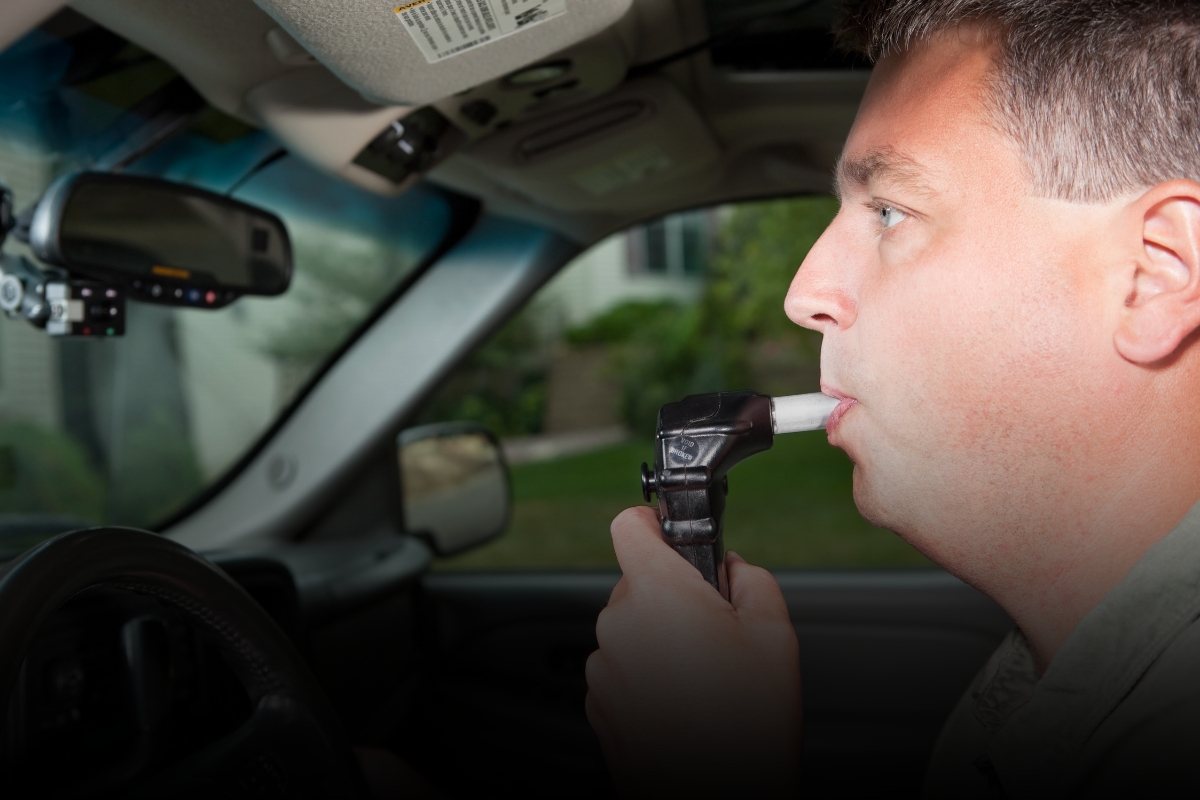
An ignition interlock is a breath testing device wired into your ignition. You blow before the engine starts, and again while driving. In North Carolina the requirement comes from two statutes doing two different things, and confusing them is the most common mistake people make after a DWI conviction. One interlock rides on a limited driving privilege while your license is still revoked. The other attaches after DMV restores it.
What triggers the interlock requirement
NCGS 20-17.8 applies when your license was revoked for a conviction of driving while impaired under NCGS 20-138.1 and any one of these is true:
- You had an alcohol concentration of 0.15 or more, which DMV determines from the chemical analysis affidavit executed under NCGS 20-16.2(c1).
- You have another impaired driving conviction for an offense within the seven years immediately preceding the offense that got your license revoked.
- You were sentenced under NCGS 20-179(f3), Aggravated Level One.
The statute also reaches habitual impaired driving under NCGS 20-138.5 and most convictions under NCGS 20-141.4. The 0.15 threshold is the one that catches ordinary first offenders. No prior conviction, no crash. One reading of 0.15 puts you inside NCGS 20-17.8 for years.
Sentencing levels, and why they matter here
NCGS 20-179 sets six punishment levels. The judge counts grossly aggravating factors first: a prior impaired driving conviction within seven years, driving while revoked for impaired driving, serious injury to another person, or a child under 18 in the vehicle. Three or more means Aggravated Level One, and the child factor alone means Level One. With none, the judge weighs ordinary factors and lands on Level Three, Four or Five.
| Level | Maximum fine | Imprisonment |
| Aggravated Level One | $10,000 | 12 to 36 months, no parole. Suspension needs 120 days special probation |
| Level One | $4,000 | 30 days to 24 months. Suspension needs 30 days, or 10 with 120 days of alcohol monitoring |
| Level Two | $2,000 | 7 days to 12 months. Suspension needs 7 days, or 90 days monitored abstinence |
| Level Three | $1,000 | 72 hours to 6 months. Suspendable with 72 hours jail or service |
| Level Four | $500 | 48 hours to 120 days. Suspendable with 48 hours jail or service |
| Level Five | $200 | 24 hours to 60 days. Suspendable with 24 hours jail or service |
Levels Three, Four and Five keep a first offender eligible for a limited driving privilege under NCGS 20-179.3(b)(1). An alcohol concentration of 0.15 or more is itself an aggravating factor under 20-179(d)(1).
The limited driving privilege interlock
A limited driving privilege lets you drive on a revoked license for essential purposes: work, household maintenance, education, court-ordered treatment, community service, emergency medical care and religious worship. Standard working hours under NCGS 20-179.3(f1) are 6:00 a.m. to 8:00 p.m., Monday to Friday.
NCGS 20-179.3(g5) makes interlock mandatory in the privilege if your alcohol concentration was 0.15 or more, or if you qualify under subsection (b)(3) with one prior impaired driving conviction inside seven years. The judge must order that you drive only a designated vehicle, that it carry an approved interlock set to block driving above 0.02, and that you personally activate the device.
Here is the part almost nobody knows. When the privilege includes the (g5) restrictions, the hour and purpose limits in subsections (a), (f), (g), (g1) and (g2) do not apply while you operate that designated vehicle with a working interlock. You can drive it at 2:00 a.m. on a Sunday.
The old 45-day waiting period is gone. Subsection (c1), which forced a 0.15 offender to wait 45 days into the revocation before a privilege took effect, was repealed by Session Law 2021-182, effective 1 December 2021. Pages still quoting it are years out of date. One more trap: remove the interlock before the revocation period ends and the privilege is void.
How long the post-restoration interlock lasts
NCGS 20-17.8(c) ties the interlock period to the original revocation, and the revocation length comes from NCGS 20-19.
| Prior record | Revocation under 20-19 | Interlock under 20-17.8(c) |
| First DWI conviction | 1 year | 1 year from restoration |
| Another impaired driving offense within 3 years | 4 years, conditional restoration possible after 2 years | 3 years from restoration |
| Two or more priors with the most recent within 5 years, or sentenced under 20-179(f3) | Permanent, conditional restoration possible after 3 years | 7 years from restoration |
Time spent driving on a limited driving privilege with the (g5) interlock counts. NCGS 20-17.8(d) applies that period toward the subsection (c) requirement. Get the privilege promptly, drive on it for a year, and you may satisfy a one-year post-restoration requirement with no additional interlock time.
The alcohol limits you have to live with
Three separate numbers apply, and they are easy to mix up.
- 0.02 on the interlock. NCGS 20-17.8(b)(3) prohibits driving at 0.02 or greater, and vendors report every start attempt above it.
- 0.04 on a first restoration. NCGS 20-19(c3)(1) separately bars a first-time DWI restoree from operating any vehicle at 0.04 or more.
- 0.00 on a second or later restoration. NCGS 20-19(c3)(2) drops it to greater than 0.00.
Those NCGS 20-19(c3) restrictions run three years in most cases, and seven years where the revocation was permanent. They apply to every vehicle you drive, not just the designated one. A driver off interlock but inside the three-year window can be revoked for a 0.05 reading in a car with no device in it.
What happens when you violate
A violation is not a paperwork problem. Under NCGS 20-17.8(f) it is the offense of driving while license revoked for impaired driving under NCGS 20-28(a1). If a judicial official finds probable cause, your license is suspended pending resolution. Violate a restriction without being charged and NCGS 20-17.8(g) still revokes your license for one year.
There is a narrower rule for the home stretch. Under NCGS 20-17.8(g1), a violation during the 90-day period immediately before your requirement was due to end extends it by another 90 days, or until you have been violation-free for that period. The same extension applies to a privilege under NCGS 20-179.3(j2), and it stays in force while any appeal is pending. Tampering is its own crime: NCGS 20-17.8A makes it a Class 1 misdemeanor, each act a separate violation.
One protective detail. An alcohol concentration report from the device is not admissible as evidence of driving while license revoked, or in the administrative revocation proceeding, unless you actually operated the vehicle when it recorded a reading in violation. A failed start attempt in a parked car is not driving.
What it costs and who pays
NCGS 20-179.5(a) is blunt. The person ordered to install the system pays for installation and monitoring, on terms agreed with the vendor.
Vendors serving North Carolina publish these ranges as of mid-2026: installation from roughly $30 to $300 depending on vehicle and device, a deposit around $50 to $77, and monthly lease and monitoring between about $50 and $92. One provider advertises roughly $2.50 per day, and removal is billed separately. State fees sit on top. Restoration after a revocation under NCGS 20-17(a)(2) costs $167.25 under NCGS 20-7(i1), against $83.50 otherwise, and the 30-day civil revocation under NCGS 20-16.5 carries a $100 fee.
If you cannot afford the device, NCGS 20-179.5 has real teeth. Apply to an authorized vendor with an affidavit on a DMV form stating either that your income is at or below 150 percent of the federal poverty line, or that you are enrolled in TANF, SSI, SNAP, LIHEAP or Medicaid. Back it with a tax return, a W-2, or three months of pay stubs. A vendor receiving a complying application must not charge for installation or removal, and must give a 50 percent discount on the monthly rate.
The two interlock waivers, and why people ask for the wrong one
North Carolina has two entirely separate forms of interlock relief. They sit in different statutes, you apply for them in different places, and they are granted for different reasons. A search for a North Carolina interlock waiver almost never specifies which one, and asking the wrong office for the wrong one costs weeks.
| Cost waiver | Medical exception | |
|---|---|---|
| Authority | NCGS 20-179.5(b) through (f) | NCGS 20-17.8(l) |
| What it excuses | Part of the cost. You still have the device. | The device itself. |
| Who qualifies | Anyone required to install who cannot afford it, at or below 150 percent of the federal poverty line, or enrolled in TANF, SSI, SNAP, LIHEAP or Medicaid. | Only a person subject to 20-17.8 solely because of the 0.15 trigger in subsection (a)(1), who has a medically diagnosed physical condition making them incapable of personally activating the device. |
| Who is barred | No categorical bar. | Expressly unavailable to anyone subject under (a)(2), a prior impaired driving offense within seven years, or (a)(3), sentencing under NCGS 20-179(f3). |
| Where you apply | To the authorized vendor, on an affidavit form created by the Division. | To the Division, with a certificate completed and signed by two or more licensed physicians or surgeons. |
| If granted | No installation or removal charge, and a 50 percent discount on the monthly service rate. | No interlock requirement. |
| If denied | Review by the Division of the vendor’s determination, NCGS 20-179.5(f). | Review by a reviewing board on written request filed within 10 days of the denial, NCGS 20-9(g)(4). |
The medical exception is the one almost nobody has heard of, and its limit is the whole point. NCGS 20-17.8(l) closes by stating that the subsection does not apply to persons subject to an interlock requirement for the reasons set out in subdivision (a)(2) or (a)(3). In plain terms, if your interlock is there because of a prior impaired driving conviction within seven years, or because you were sentenced at Aggravated Level One, no physical condition will get you out of it. The exception exists only for the first offender caught by the 0.15 trigger.
Even for that driver it is not a formality. The Commissioner is not bound by what the examining physicians recommend, only required to give the recommendation fair consideration, and the statute places the burden of proof on the person seeking the exception.
The approved vendor situation
North Carolina does not run a single-vendor monopoly by statute. NCGS 20-17.8(b)(1) requires a device “of a type approved by the Commissioner,” tells the Commissioner not to unreasonably withhold approval, and directs consultation with the Division of Purchase and Contract so vendors are not discriminated against. Confirm with NCDMV that your chosen company is currently certified before you pay a deposit, and ask about service centers near you.
Did the law change in 2025 or 2026?
Yes, but not the part most people ask about. NCGS 20-17.8 was last amended by Session Laws 2024-30 and 2024-43. Nothing in the 2025 or 2026 sessions changed the triggers in subsection (a), the one, three and seven year periods in subsection (c), or the 0.02 restriction.
What did change is Session Law 2025-71, Senate Bill 311, the Law and Order Act, signed 9 July 2025. Section 11 created a new mitigating factor at NCGS 20-179(e)(6b). Before trial, the defendant voluntarily equipped a designated vehicle with an approved interlock, drove only that vehicle for at least six months, and produced evidence satisfactory to the judge of no start attempt above 0.02 and no other policy violation. It is limited to defendants charged under NCGS 20-138.1 whose vehicle was not in a crash causing serious injury or death, who held a valid or recently expired license, and who had no other unresolved impaired driving charge. Section 11 also let a voluntary installer apply for the affordability waiver. Both took effect 1 December 2025.
Installing an interlock voluntarily and running clean for six months before trial is now a statutory mitigating factor, and mitigating factors move a case from Level Three to Level Five. Decide early, not on the courthouse steps.
See also North Carolina DWI defence. If your case involves a domestic protective order, start with North Carolina protective orders.
FAQ
How long will I have the interlock? It tracks the length of your revocation, not your BAC. NCGS 20-17.8(c) requires one year from restoration if the original revocation was one year, three years if it was four years, and seven years if the revocation was permanent.
How much does an interlock cost per month? Vendors serving North Carolina advertise monthly lease and monitoring of roughly $50 to $92, with one provider quoting about $2.50 per day. Installation runs $30 to $300 depending on the vehicle. NCGS 20-179.5(a) puts those costs on the person ordered to install the device, but that is not the end of it. Under NCGS 20-179.5(b) and (e), a driver at or below 150 percent of the federal poverty line, or enrolled in TANF, SSI, SNAP, LIHEAP or Medicaid, can apply to the vendor for a cost waiver, and a vendor that receives a complying application must waive installation and removal charges entirely and cut the monthly rate by 50 percent.
Can I drive my work vehicle? On a limited driving privilege, yes, in narrow circumstances. NCGS 20-179.3(g4) exempts a vehicle owned by your employer and operated solely for work purposes, where the owner has filed a written authorization with the court. No such exemption appears in NCGS 20-17.8.
Can I have one drink and still start the car? No. The device blocks a start attempt at 0.02 or above, roughly one drink for many adults. Your restored license carries a separate restriction of 0.04 on a first restoration and greater than 0.00 on a second.
What happens if the device records a failed test? The vendor reports every start attempt above 0.02 to the Commissioner. If you were not driving, the report alone is not admissible as evidence of driving while license revoked. If you did drive, NCGS 20-17.8(g) revokes your license for a year.
Do I need an interlock on every car I own? No. You designate the registered vehicles you own and intend to operate, and those get the device. DMV can cancel your license for driving an undesignated vehicle or for removing a device from a designated one.
Can I get the interlock removed early? Not by asking. Removing the device before the revocation period ends voids a limited driving privilege outright under NCGS 20-179.3(g5). A violation in the final 90 days extends the requirement by another 90 days.
Do I still have to wait 45 days for a limited driving privilege? No. The 45-day wait that applied to drivers at 0.15 or more lived in NCGS 20-179.3(c1), repealed by Session Law 2021-182 effective 1 December 2021. Any page saying otherwise is years out of date.
Did North Carolina change the interlock law in 2025 or 2026? The core statute did not. What changed is Session Law 2025-71, effective 1 December 2025, which made voluntary pre-trial interlock use for at least six months a mitigating factor under NCGS 20-179(e)(6b).
Can I get out of the interlock for medical reasons? Only in one narrow situation. NCGS 20-17.8(l) allows a medical exception for a person with a medically diagnosed physical condition that makes them incapable of personally activating the device, but only where the interlock was triggered solely by an alcohol concentration of 0.15 or more. The subsection expressly does not apply to a person required to have the device because of a prior impaired driving offense within seven years, or because they were sentenced under NCGS 20-179(f3). It requires examination by two or more licensed physicians or surgeons, the Commissioner is not bound by their recommendation, and the burden of proof is on the applicant. A denial can be reviewed by a reviewing board if you request it in writing within 10 days.
Related
- Ignition interlock violations in North Carolina
- Interlock violations, early removal and tampering in North Carolina
- What a DWI actually costs in North Carolina