

A 50C civil no-contact order starts in civil court, but it can still impact your criminal case.
In North Carolina, a 50C no-contact order is a civil court order that limits contact in some sexual assault or stalking cases. It can also affect how a related criminal case is managed.
North Carolina courts can consider existing civil no-contact orders when deciding on matters such as bond and pretrial conditions in criminal cases.
If you are unsure how a 50C order might affect your criminal case, consulting a North Carolina criminal defense attorney early can help you understand your situation.
Book a call or leave us a message on our contact page
What exactly is a 50C no-contact order under North Carolina law?
A 50C no-contact order in North Carolina is a civil court order used to prevent contact in cases of non-domestic sexual assault or stalking. It applies when the people involved are not in a domestic relationship, so domestic violence laws under Chapter 50B do not apply.
Once served, a 50C order may:
- Prohibit direct and indirect contact.
- Limit how close you can be to the other person
- Remain in effect even if no criminal charges are filed.
Although the order itself is civil, its violation constitutes a criminal offense. Learning what the order covers early on can help you avoid breaking it by mistake.
Does a 50C no-contact order automatically lead to criminal charges?
No. A 50C order in North Carolina does not automatically result in criminal charges and does not decide guilt.
However, if there is:
- A pending criminal investigation
- An active criminal charge
- Or later allegations of prohibited contact
The criminal court may still consider the existence of the 50C order when handling your case.
If this is your situation, getting legal advice early can help you understand your options.
Where civil no-contact orders intersect with criminal court decisions
A 50C order does not determine the outcome of a criminal case, but it may affect how courts handle certain aspects of the process.
Civil and criminal courts have distinct roles, but they often rely on the same information. A 50C order may affect a judge’s assessment of risk, compliance, and supervision while a criminal case is ongoing.
| Issue | 50C Civil No-Contact Order | Criminal Case |
| Type of case | Civil court matter | Criminal court matter |
| Purpose | Restrict contact | Address alleged criminal conduct |
| Determines guilt | No | Yes |
| Can exist without charges | Yes | No |
| Consequences for violations | Criminal charges possible | Criminal penalties |
| Court focus | Contact restrictions | Public safety and compliance |
The chart below shows where this overlap typically occurs in a criminal case
Areas of a Criminal Case a 50C Order Can Affect in North Carolina
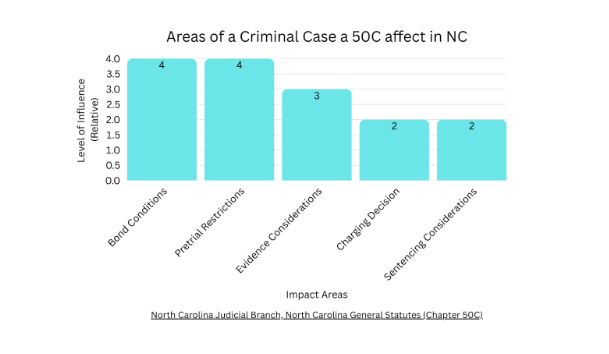
This chart outlines general court procedures and factors courts may consider. It does not predict the outcome of any specific case.
Are bond and pretrial conditions usually affected first?
Yes. When a criminal case is pending, courts focus on compliance and managing risk. Having a 50C order can affect how judges set bond and release conditions.
Courts may:
- Impose stricter bond terms.
- Expand no-contact requirements
- Add location or communication restrictions.
Knowing your bond conditions from the beginning can help you avoid bigger problems later.
Can a 50C influence charging or prosecution decisions?
Yes, but only indirectly. A civil no-contact order does not decide whether criminal charges are filed. That choice is up to law enforcement and prosecutors.
However, prosecutors may review:
- Allegations included in the 50C filing
- Statements made during civil proceedings
- Any reported violations after service
A North Carolina criminal defense attorney can explain how this might affect your case.
What happens if a 50C order is violated during a criminal case?
If you violate a 50C no-contact order, you could face new criminal charges. Breaking the order is a separate offense under North Carolina law.
When a violation occurs while another criminal matter is pending, possible outcomes include:
- Additional criminal charges
- Bond modification or revocation
- Increased court supervision
Knowing your court orders well can help you avoid more legal trouble.
Can statements made in a 50C case be used later in criminal court?
Yes. Statements made in civil court may be used in a criminal case.
This includes statements made:
- Under oath
- In written filings
- Du
- ring civil hearings
Understanding how this overlap works can help you protect yourself as your case continues.
What should you remember about a 50C order in NC?
- A 50C order is a civil matter, but breaking it is a criminal offense.
- It can influence bond and pretrial conditions.
- Courts may consider it during case management decisions.
- Getting legal advice early can help you avoid extra complications.
If you are dealing with both a 50C no-contact order in NC and a criminal case, it is important to understand how they are connected.
How does Martine Law handle cases involving both civil and criminal courts?
When civil and criminal matters overlap, it is important that all issues be handled in a coordinated manner. What happens in one court can affect what happens in another.
Martine Law is a North Carolina law firm that handles both criminal defense and related civil matters under a single strategy, rather than treating them as separate cases. This helps reduce confusion and lowers the risk of conflicting legal positions.
If you want a more precise explanation of how this approach may apply to your situation. You can call (704) 842-3411 for a more detailed answer.