



An arrest for a drug-related offense often creates an immediate sense of finality. Many people anticipate that the charge listed on the police’s official arrest record is fixed and will remain the same throughout the case.
However, the charges outlined in the police report are only the starting point. In North Carolina, charging decisions are framed primarily after an arrest and before a case reaches court.
This requires a clear understanding of the N.C. drug court process to reduce doubt, confusion, and uncertainty, and to clarify your rights and the steps that typically follow.
These changes are part of a structured legal process that unfolds between arrest and court, shaped by evidence review, legal standards, and prosecutorial discretion.
Knowing what typically happens during this phase helps individuals understand why early assumptions about a case outcome are often unreliable.
Martine Law offers process-focused guidance to help you better understand what happens next.
Contact us to learn more about how these cases are commonly reviewed under North Carolina law.
Why Arrest Charges Are Not Always Final
When arresting individuals, police officers make charging decisions based on the information available at that time. This may include physical evidence, statements, and observations made during the encounter. These charges are often provisional rather than conclusive.
The arrest charges serve primarily to initiate the legal process. The law explicitly empowers North Carolina Recovery Courts to assume jurisdiction and initiate a formal review.
This means the charge at arrest does not represent the final determination of how a case will proceed.
The Time Between Arrest and Court Matters
In North Carolina, the case evaluation primarily depends on when the police arrest the person on drug charges and initially present the suspect in court. During this phase, the court reviews the evidence more closely, assesses legal sufficiency, and determines whether the initial charge complies with statutory requirements.
This review period is critical in drug cases, where factors such as substance, classification, quantity, and context can significantly affect how a charge is framed. During this window, the difference between arrest and drug charges in NC may be amended, refined, or reclassified.
Publicly reported arrest data helps explain why charging decisions often require further review after an arrest. In North Carolina, most drug arrests involve possession-related offenses, which are particularly dependent on classification, quantity, and evidence confirmation.
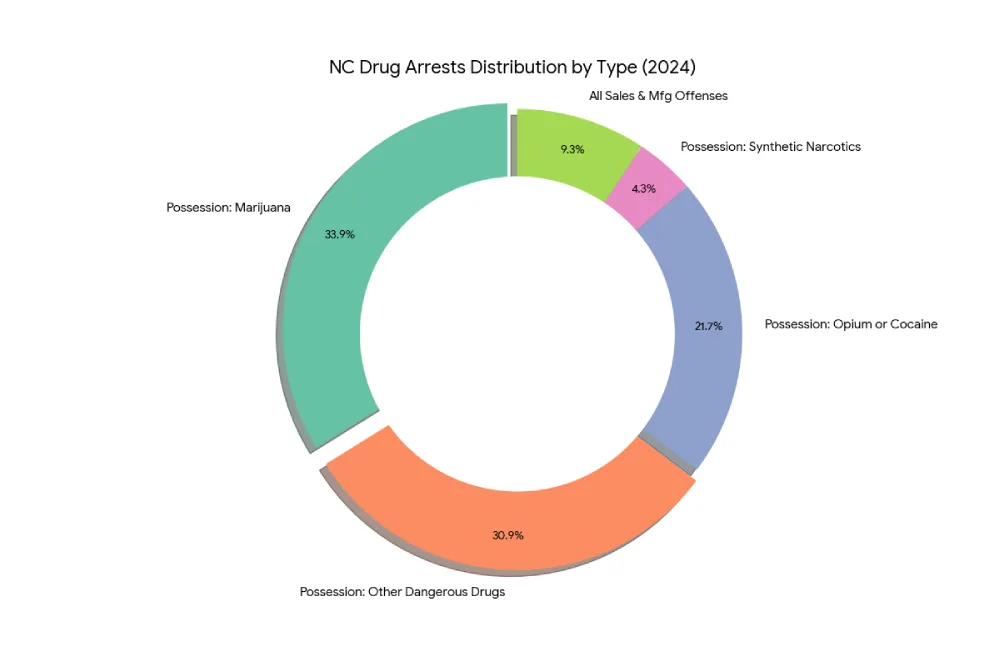
Distribution of Drug Arrests by Offense Type in North Carolina (2024)
The majority of drug arrests involve possession offenses, which often require a detailed review before charges are finalized in court.
Who Reviews and Adjusts Drug Charges: Judge, Prosecutor, or the Police
Another key question is who has final authority to review and adjust drug charges. The prosecutor is the ultimate charging authority. It is not the judge or the police. While the law enforcement officer initiates charges, prosecutors are responsible for determining whether those charges are appropriate under the North Carolina Controlled Substances Act.
Additionally, prosecutors review cases to ensure charges meet legal standards and are supported by admissible evidence. This independent review is one reason changes often occur after arrest.
What Prosecutors Review Before Finalizing Drug Charges
Prosecutors typically evaluate several factors before finalizing drug charges and moving the case to court. These considerations explain why a charge may differ after arrest from its initial recording.
Factors that commonly influence charge changes:
- The strength and admissibility of the evidence
- Laboratory testing results confirming the substance type
- Quantity thresholds defined by statute
- Prior case law affecting classification
These factors are reviewed carefully to ensure the charge aligns with North Carolina statutes and prosecutorial guidelines.
A Closer Look At How Drug Charges Evolve Before Court
It is crucial to note that multiple procedural checkpoints enable the court to shape charging decisions in drug cases. Let’s identify the common review stages and explain how each stage can affect whether charges change before the N.C. drug court process.
| Particular Review Stage in the Court | How Does it Matter to the Case |
| Assessment of the Evidence | Determines whether evidence supports the charge |
| Confirmation from the Lab | Confirms substance identity and classification |
| Beginning with the Legal Review | Ensures charge matches statutory requirements |
| Prosecutorial Discretion | Evaluates proportionality and case viability |
Why Drug Quantity and Classification Are So Important
In North Carolina, drug charges are governed strictly by General Statute 90-95. The severity of a charge is determined by two main levers: the Classification (Schedule) of the drug and the Quantity in your possession. Thresholds established by statute can separate misdemeanor offenses from felony charges.
- Substance classification determines whether the charge falls under misdemeanor or felony statutes
- Quantity thresholds set by law can change the severity level of a charge
- Laboratory testing may confirm or contradict initial assumptions made at arrest
- Weight measurements can affect how offenses are categorized under state law
- Statutory definitions guide how prosecutors evaluate charging accuracy
The drug cases and the type and amount of substance involved often play a central role in how charges are categorized. It also explains why charges may change between arrest and court as additional information becomes available.
Why Early Charge Changes Don’t Tell the Whole Story
If your drug charges are changed before your court date, it does not mean your case will ultimately resolve that way. It simply reflects an adjustment based on fuller information and legal review.
The court or prosecutors will recognize that early arrest decisions are made quickly, whereas later reviews are more deliberate. Understanding this distinction helps manage expectations and reduces unnecessary assumptions about outcomes.
Because early charge changes are part of a broader review process, many people look to experienced criminal defense lawyers for clarity on how charging decisions are evaluated as a case moves forward.
Clearing Up Common Assumptions About Changing Charges
Changes to drug charges between arrest and court are often misunderstood. These assumptions can create unnecessary uncertainty and confusion during the early stages of a case.
- A change in charges does not automatically mean the case is getting better or worse
- Initial arrest charges are not final determinations of guilt or outcome
- Charge revisions often reflect evidence review, not negotiation or strategy
- Prosecutors may adjust charges to align with statutory requirements
- Early changes do not predict how the court will ultimately rule
Clarifying how and why charges evolve helps individuals better understand the process without overinterpreting early developments.
A Clearer View of How Drug Charges Evolve Before Court
The period between arrest and court is not static. It is a review-driven phase in which evidence is examined, classifications are confirmed, and legal standards are applied more carefully than at the time of arrest.
Therefore, a clear and comprehensive understanding of the NC drug court process helps explain why early charges should not be viewed as final determinations but as part of an evolving legal system.
If you have questions about how charging decisions are reviewed and adjusted as a drug case moves from arrest toward court, Martine Law provides clear, process-focused insight grounded in North Carolina criminal law.
Please contact us at +1 (704) 842-3411 to better understand how charging decisions are typically evaluated during this critical stage.
Frequently Asked Questions About Drug Charge Changes in North Carolina
Why can drug charges change after an arrest in North Carolina?
Drug charges may change after arrest because the initial charge is based on limited, immediate information. Prosecutors later review evidence, lab results, substance classification, and legal standards. This review helps ensure the charge accurately reflects the facts and complies with North Carolina law before the case proceeds further.
Who decides whether drug charges should be changed?
While law enforcement officers initiate charges at the time of arrest, prosecutors ultimately decide whether to adjust them. They review evidence, apply statutory requirements, and assess whether the charge is legally appropriate. This process occurs between arrest and court and reflects procedural review rather than a final outcome determination.
Does a change in drug charges mean the case outcome is decided?
No. A change in drug charges does not determine how a case will ultimately resolve. Charge adjustments simply reflect updated information or legal review. Courts and prosecutors recognize that early charges are preliminary, and final outcomes depend on multiple factors addressed later in the legal process.
Why are drug quantity and classification reviewed so carefully?
Drug quantity and classification directly affect how offenses are categorized under North Carolina law. Laboratory testing may confirm or alter initial assumptions made at the time of arrest. Because statutory thresholds matter, careful review helps ensure that charges accurately reflect the substance of the offense and the amount attributed to it.
How long does the charge review process usually take?
There is no fixed timeline for charge review. The process typically occurs between arrest and early court appearances and depends on factors such as lab testing, evidence evaluation, and prosecutorial workload. Some reviews happen quickly, while others take longer depending on case complexity.